The Only Guitar Picking Exercise You'll Ever Need
Practice "The Crooked Spider" 10 Minutes A Day And Surprise Yourself
To improve our musical skills, there are a lot of different exercises to practice. We have tons of options, and sometimes, when we sit down to start our practice session, we ask ourselves: what I'm going to practice now?
Today I want to make things as simple as possible and show you one exercise that you can do every time you have 5 minutes to spare or you feel not sure about what material to focus on.
I admit that if I would have to choose one only exercise I'm allowed to use to keep my technique good, this will be the one.
Introducing The Crooked Spider Guitar Exercise
These are the guitar tabs and audio for the exercise, that I called "The Crooked spider" (il ragno storto, in the Italian language).
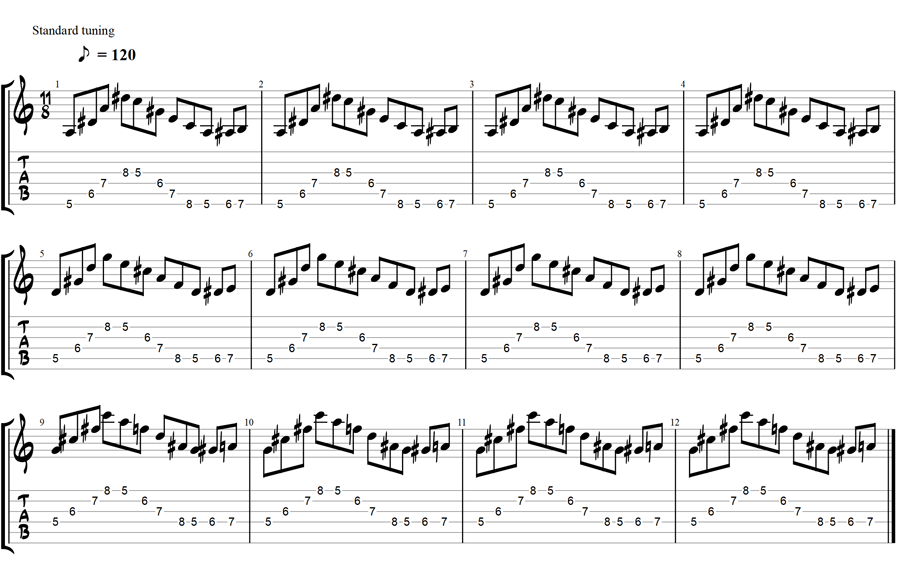
As you can see, the time signature is strange: 11/8. That's the reason the Spider is crooked.
Here are the main benefits of practicing this sequence every day (even if only 10 minutes per day):
- All four fingers of your left hand are put at work in the same way
- There's a lot of string crossing, this is a great challenge for alternate picking (as you probably already know, on the guitar is way easier to play a sequence of notes on the same string than crossing strings)
- As this is an odd sequence (11/8) you have to invert the picking direction at the beginning of each bar (down picking vs up picking). This allows you to practice all the possible picking motions.
Tips To Practice This Exercise
For the maximum benefit, it's important that you execute the Crooked Spider exercise in the right way. Here are some suggestions you should follow:
- Try to strictly use alternate picking. This exercise is conceived to invert picking direction at any bar, so it's crucial you follow the down-up-down-up-down-up-down route. You can begin the exercise with an up stroke or a down stroke, it does not matter, because at the beginning of each bar, the direction will be inverted (due to the odd number of notes per bar)
- Use one finger per fret. So index for the notes on the 5th fret, medium for the 6th fret, ring for the 7th, and pinkie on the 8th fret.
- Play with clean and distorted sound. With the clean sound, you can spot dynamics inconsistency and semi-dead notes. With a distorted sound, you can check if you are muting strings correctly, an issue that can emerge when you cross strings, and here you're going to cross strings a lot.
- Always use a metronome, starting from low bpm and increasing a little bit every time you feel confident. It might be helpful to use an eighth beat, to stay in sync with the odd time signature.
- Occasionally, forget the metronome and play little fragments as fast as you can: the first 2 notes of the pattern, then 3, then 4, and so forth. This helps unblock the hands.
- If possible, record yourself and then listen to the tracks to spot imperfections in timing and sound.
If you have difficulties in memorizing this exercise, try to break it down into 3 main sections: the first section, ascending strings and frets 1-2-3-4, the second descending strings 1-2-3-4, and the last section with 3 chromatic notes 1-2-3
You might also find useful my detailed guide on how to increase speed on guitar.
That's all for today. Try this exercise for some days, and see if and how your skills will improve! To stay updated, jump to this link.
I'll leave you with this quote which I found of great inspiration:
You've got to learn your instrument. Then, you practice practice, practice. And then, when you finally get up there on the bandstand, forget all that and just wail.
Charlie Parker
Update: I realized that Crooked Spider is also a brewing company from The Netherlands, congratulations to them for the naming :-)
FAQ
What makes 'The Crooked Spider' picking exercise uniquely effective for guitar technique development?
The Crooked Spider is highly effective because it simultaneously engages all four fingers of your left hand, presents significant string-crossing challenges for alternate picking, and its unusual 11/8 time signature forces you to invert your picking direction at the beginning of each bar, ensuring practice of all possible pick strokes.
How does the 11/8 time signature specifically improve alternate picking skills?
The 11/8 time signature means there's an odd number of notes per bar. This forces you to alternate your starting pick stroke (downstroke or upstroke) with each new bar. For example, if you start with a downstroke in one bar, the next bar will naturally begin with an upstroke, ensuring you develop fluidity and control with both initial picking directions.
Why is it recommended to practice 'The Crooked Spider' with both clean and distorted guitar sounds?
Practicing with a clean sound helps you identify inconsistencies in dynamics and any semi-dead notes. Using a distorted sound is crucial for checking your string muting technique, especially when frequently crossing strings, as any unmuted strings will become much more noticeable.
What is the correct left-hand fingering for 'The Crooked Spider' exercise?
The exercise uses a 'one finger per fret' approach. You should use your index finger for notes on the 5th fret, your middle finger for the 6th fret, your ring finger for the 7th fret, and your pinkie finger for the 8th fret.
What's the best way to use a metronome when practicing 'The Crooked Spider' with its 11/8 time signature?
Start with a very low BPM and gradually increase it as you gain confidence. To stay in sync with the odd time signature, it's particularly helpful to set your metronome to click on an eighth beat, providing a clear subdivision for each count.
Are there any tips to help memorize or speed up 'The Crooked Spider' exercise besides strict metronome practice?
Yes, to aid memorization, you can break the exercise into three main sections: ascending strings and frets (1-2-3-4), descending strings (1-2-3-4), and the final three chromatic notes (1-2-3). To unblock your hands and improve speed, occasionally forget the metronome and practice playing small fragments (like the first 2, 3, or 4 notes) as fast as you can.