Blues Chord Tones Exercises
Develop Your Lead Guitar Skills With Chord Tones Targeting In a Blues Context
In this article, I want to suggest some simple exercises useful for developing chord tone solos and note targeting ability in a Blues context.
We will be using dominant chords, which are at the foundation of the Blues; to get chord tones under our skin, we're going to play dominant arpeggios focusing on different target notes.
Practice these exercises until the movements from one chord to another become second nature, and your Blues lead guitar skills will benefit a lot.
On your free download page you find the tabs and the Guitar Pro files for all the exercises.
Arpeggio Shapes Used In The Exercises
We'll move around A7 (I), D7 (IV), and E7 (5) chords.
For these exercises, we want to stay in one fretboard position, (around the 5th fret), using different fingerings, so here below are the arpeggio shapes that we're going to use.
A7 Dominant Chord Shape
The A7 dominant chord is composed of A (1), C# (3), E (5), and G (b7).

D7 Dominant Chord Shape
D (1), F# (3), A (5), and C (b7) are the notes in a D7 chord.

E7 Dominant Chord Shape
The E Dominant Seventh chord is made up of the notes E (1), G# (3), B (5), and D (b7).

Why do we have to use arpeggios instead of scales?
Chord tones soloing, which consists in playing melodic lines using the notes of the backing chords as main notes, is a very effective way to generate solos that perfectly fit with the harmony.
In fact, using chord tones as building blocks in our phrasing, has a nice effect to make perceiving the harmony in the lead guitar part.
Of course, you are free to use also any other notes, like notes in the scales and even chromatic passages, but your melodic lines should be mostly based on chord tones.
Chords Movements
The base structure of a 12 bar Blues song is:

To allow you to focus on chord tones targeting, the following exercise will be based on the main chord changes that usually appear in a 12 bar blues song:
- I to IV (A7 to D7)
- I to V (A7 to E7)
- V to IV and to I (E7, D7, A7)
Try to hear the chord changes in your melodic lines.
Blues Chord Tones Soloing Exercises
I to IV Movement (A7 to D7)
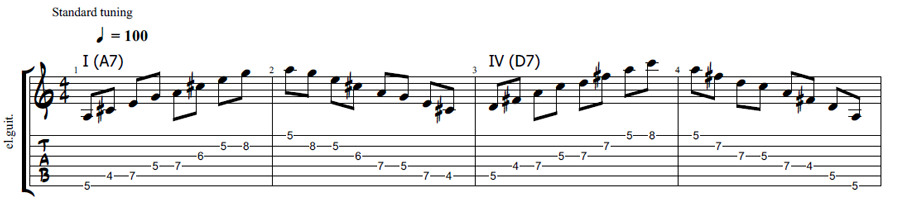
I-IV Exercise 1 - Ascending Arpeggios
In this first warmup exercise you'll be playing ascending A7 and D7 arpeggio starting from the root of each chord. Notice how well the chord change is highlighted by the solo guitar.
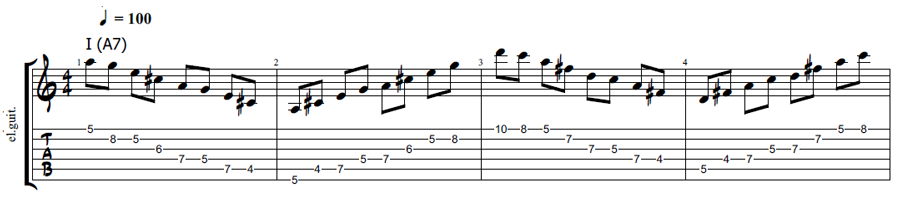
I-IV Exercise 2 - Descending Arpeggios
Same as the exercise before, but this time we're going to play descending arpeggios. To start each bar from the corresponding chord root, we have to make a shift to fret 10th (D):
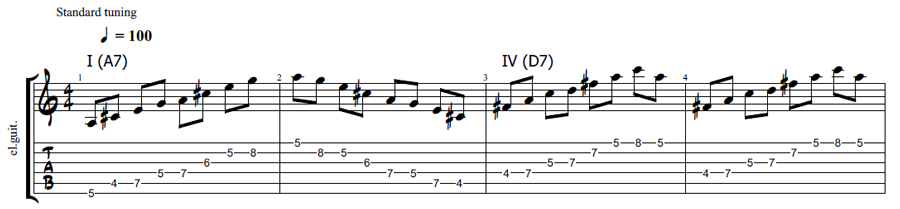
I-IV Exercise 3 - Targeting the 3rd
Here we will be targeting the 3rd of D7 chord, which is F#, when the chord change appears.
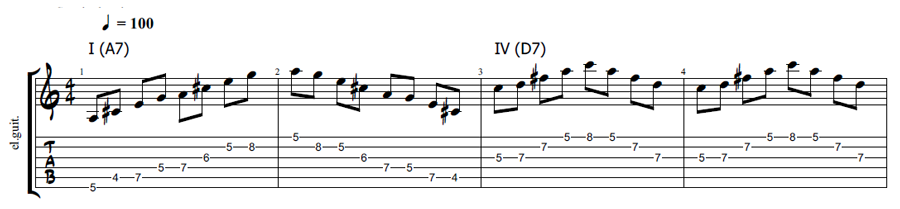
I-IV Exercise 4 - Targeting the b7
In this last I to IV chords exercise, we will play the b7 (C) on the D7 chord.
I to V Movement (A7 to E7)
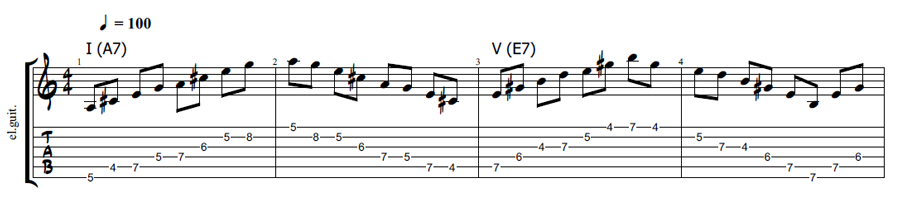
I-V Exercise 1 - Ascending Arpeggios
Here we play two ascending arpeggios, A7 and E7, starting from each root.
Notice the resolution feeling when the song ends, moving from E7 to A major.
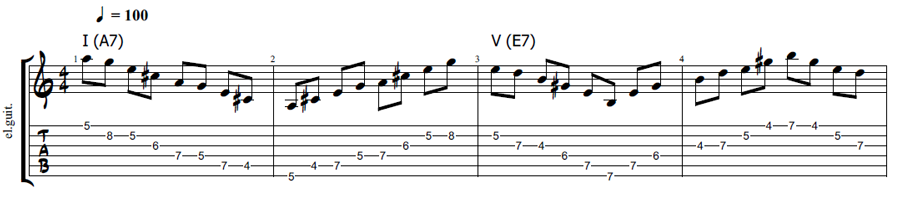
I-V Exercise 2 - Descending Arpeggios
Here we play two descending arpeggios, A7 and E7, starting from the upper octave roots.
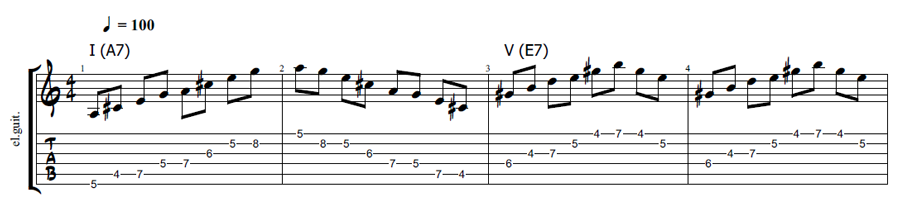
I-V Exercise 3 - Targeting the 3rd
Here, on E7 we're going to target the 3rd, G#:
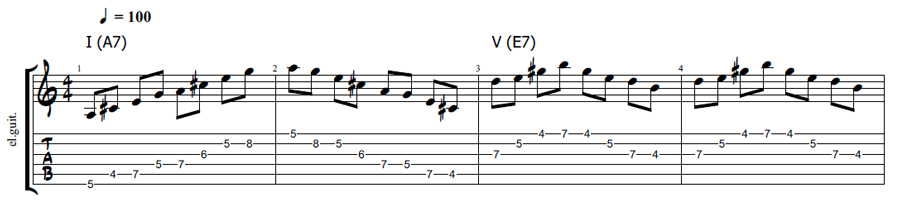
I-V Exercise 4 - Targeting the b7
Finally, when the A7 to E7 switch appears, we target the b7 (D)
I IV I Movement (E7 to D7 and A7)
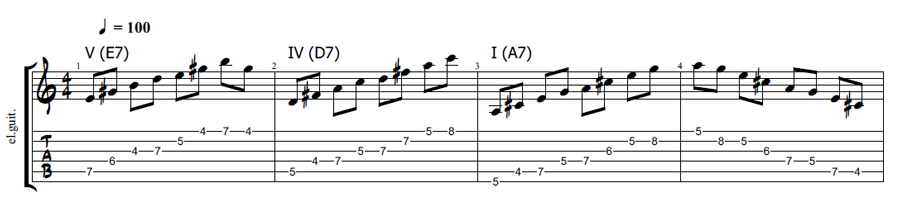
V-IV-I Exercise 1 - Ascending Arpeggios
In this exercise, we're going to play an ascending arpeggios starting from each root: E7, D7 and A7.
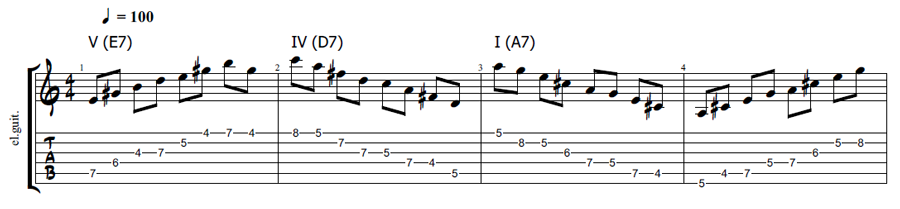
V-IV-I Exercise 2 - Ascending and descending arpeggios mix
In this exercise, we play an ascending arpeggio on E7, then a descending arpeggio starting from the b7 on D7 (C), and a descending arpeggio from the root on A7.
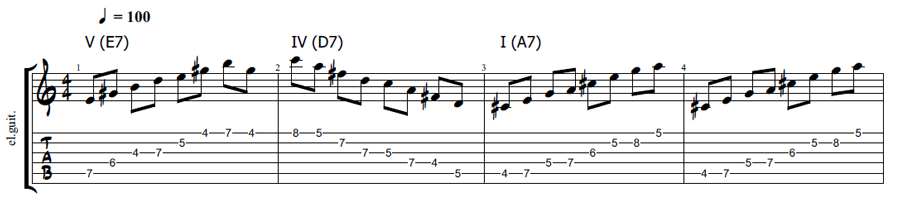
V-IV-I Exercise 3 - Ascending and descending arpeggios mix, targeting the 3rd of A7
Same as the exercise above, but on the A7 chord we will be targeting the 3rd (C#):
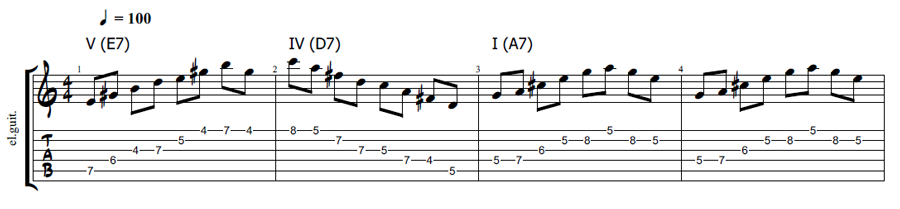
V-IV-I Exercise 4 - Ascending and descending arpeggios mix, targeting the b7 of A7
Finally, we will land on the b7 (G) when the A7 chord is played.
Blues Chord Tones Exercises - Moving Forward
I hope you get some inspiration from these simple exercises.
Chord tones are the Holy Grail of great guitar solos: instead of playing boring scales up and down, we can mostly focus on certain notes (guess which they are? use this tool) and come out with melodic lines that flow nicely with the harmony of the tunes.
There are a lot of things you could do starting from these concepts:
- Use other arpeggios, built on other types of dominant chords, such as 9, 11 and 13
- Mix arpeggios and pentatonic scales
- Add chromatic passages to get a Jazz feel.
In my complete ebook, Scales Over Chords | Learn How To Play The Right Scales Over Any Chord, you'll find some tables showing which scales match well with the chord tones of any kind of chord.
That's all for today, we can download the Guitar Pro files and the guitar tabs in pdf format on your free download page (if you are already a subscriber you should have received the link, check your email or write me).
FAQ
What are 'chord tones' and why are they important for lead guitar in a blues context?
Chord tones are the individual notes that make up a specific chord (e.g., the root, 3rd, 5th, and b7 for a dominant 7th chord). In blues lead guitar, focusing on these notes, particularly those of the dominant chords (like A7, D7, E7 in the exercises), helps your solos clearly outline the underlying harmony. This makes your melodic lines sound connected to the progression, creating a more coherent and musical solo.
Why does this lesson emphasize using arpeggios for soloing instead of just scales?
While scales provide a palette of notes, arpeggios directly highlight the chord tones, which are the 'strongest' notes of any chord. By using arpeggios, you ensure your melodic lines perfectly fit the harmony of the backing chords. This approach makes the harmony evident in your lead playing, moving beyond simply playing notes that are 'in key' to actively outlining the chord changes.
What does 'note targeting' mean, and how is it applied in these blues exercises?
Note targeting refers to intentionally emphasizing or landing on specific chord tones at crucial moments, especially when a chord changes. In these exercises, you practice targeting particular notes like the root, 3rd, or b7 of dominant chords (A7, D7, E7) as the harmony shifts. This technique helps to clearly define each new chord in your lead line, making the chord changes audible and impactful in your solo.
Why are dominant 7th chords (like A7, D7, E7) the focus of these blues chord tone exercises?
Dominant 7th chords are foundational to the blues genre. The I, IV, and V chords in a typical 12-bar blues progression are often dominant 7ths (e.g., A7, D7, E7 in the key of A). By practicing chord tone targeting over these specific chord types, you develop skills that are directly applicable and highly effective for blues lead guitar.
How do these exercises help a guitarist 'hear the chord changes' more clearly in their playing?
By consistently practicing the arpeggios and targeting specific chord tones (like the 3rd or b7) for each dominant chord (A7, D7, E7) as the progression moves, you train your ear and your fingers to recognize and respond to the harmonic shifts. This deliberate focus helps you internalize the sound of each chord tone over its respective chord, making you more attuned to the nuances of the harmony and enabling you to 'hear' the changes in your melodic lines.
Why are the 3rd and b7 (flat 7th) notes specifically targeted in some of the exercises?
The 3rd and the b7 are critical 'color' tones that define the character of a dominant 7th chord. The 3rd indicates whether the chord is major or minor, and the b7 is what gives the chord its dominant quality. Targeting these specific notes during a chord change provides strong harmonic information to the listener, making the identity and resolution of each dominant chord (A7, D7, E7) exceptionally clear and impactful in your lead playing.